

Editor’s Note
I’m so excited the latest Creator Diaries feature! This week’s edition is with AJ Eckstein, the founder of Creator Match.
I’ve followed AJ on LinkedIn for ages and have watched him build it in public from solo operator to a 35-person agency. He’s shared the story about being the first to pay out a million dollars in LinkedIn creator deals to signing seven-figure contracts with Anthropic, Notion, and HubSpot.
AJ understands B2B creator marketing better than most. Naturally he has a lot of takes on where this is all heading: more use-case storytelling over feature marketing, YouTube as becoming the most underutilized channel for tech brands, and the emerging world of creator marketing for AI search (yes, that's a thing, and brands are already spending on it).
We also got into the stuff that I think about constantly: the difference between building as a creator and building as a founder. AJ is emphatic on this one — for him, the content exists to serve the business, not the other way around, and he'll tell you that trying to be both usually means being mediocre at both. We talked about how he actually makes content work inside a 12-to-15 hour workday, what B2B marketing teams are looking for when they're sourcing creators, and the fastest way to start landing brand deals if you're just getting started.
If you're a founder trying to figure out how to show up consistently without losing your mind, a marketer thinking about how creator spend is evolving, or a creator trying to break into B2B, this one's worth your time.
Here's our full conversation below, edited lightly for clarity :)
– Taylor
Q&A with AJ Eckstein
Q: FIrst off, could you tell me more about Creator Match?
A: Creator Match builds creator programs for the fastest-growing tech brands in the world. We're very fortunate to work with companies like Anthropic, Notion, Lovable, Zapier, Gusto, Wix, Frame.io, HubSpot — the list goes on.

Early on, we were all-in on LinkedIn. We were the first LinkedIn creator marketing agency to pay out over a million dollars. LinkedIn creators were very early in that space. And then over time, the brands would say they had more questions, more things they wanted us to do. So naturally, our capabilities expanded.
Now we do way more than just LinkedIn — we call it full stack creator marketing. That means we run all short-form creator partnership channels: Instagram, TikTok, LinkedIn, Shorts, long-form YouTube, influencer gifting, brand trips and IRL, and paid media. Our roster is not a creator or talent roster. We don't sign creators exclusively — we actually sign brands and build and scale their entire creator program.
We're signing seven-figure contracts, which I feel incredibly blessed to even say. The team has grown from myself to 35 people in under two years. The Forbes top 50 AI brands list came out recently and we rep close to 20% of the brands on that list.
Brands are spending anywhere from $100K a month to a million a month* in influencer spend with us.
*Editor’s note: no, this is not a typo. A million a month.
Q: Thinking about some of these leading AI companies — what's top of mind for them in terms of working with creators and how are they building out that strategy?
A: Two things.
The first is the barrier to build has gone to zero — so it's less about "wow, I just launched this feature" and more about distribution to announce what they're doing. It's such a noisy industry right now. Every day a new brand is raising a ton of money, launching the next version of whatever they're doing, and it's moving so fast.
The second thing is we're moving away from feature marketing and more toward use case marketing. Nobody cares that GPT-whatever came out from ChatGPT. They care about the use case: if you're a creator and you use Perplexity computer and built an entire dashboard and you're getting more brand deals — that's what's selling. The problem is how do you scale that with high volume of storytelling? Creators are the best vehicle to do that. It's really becoming less of a product game and more of a distribution game. And to do that at scale, you need an agency partner like Creator Match.
Q: What does that mean for the creator? How should they optimize for some of these deals?
A: Since it's primarily software — not necessarily hardware — you should talk about the tools in your tech stack every day.
Similar to how if you drink Poppi soda and eat Starbucks and Chipotle every day, you talk about that. There's a great post format where it's like "what's in my tech stack" — if you go to your computer's desktop bar, what are those icons? What do you use them for? That's the best way to get approved by a brand.
Creators get added to sourcing lists.
Yes, you have to have an audience.
Yes, you have to create consistently.
Yes, you have to have reach.
But the question also becomes: are they right for this campaign? If it's tied to Claude, do you actually use Claude? The best way to show that you use it is if you talk about it: "I love Claude, here's my use case, here's why I upgraded to the Max plan."
The best way to get deals is to talk about the brands. Don't think of it as unpaid labor — similar to speaking, you have to do unpaid work to get to the paid. If you don't talk about any brands, the brand can't conceptualize what they look like in your content. Make it effortless.
Even if you're talking about HubSpot and it's a very natural integration, tag them. You can also reach out directly to influencer marketing or growth marketing teams and say, "Hey, I posted about Claude, I perform crazy well, I'm a power user, here's the link — would love to partner with you." That's really what's working.
Q: You recently expanded into YouTube and brought someone on to help. How are you thinking about YouTube strategy from Creator Match's perspective, and how are AI companies working with creators on that platform?
A: A lot of tech brands are not really invested in long-form YouTube the way CPG and B2C brands have been. That space is just untapped in general — there's a lot of supply of creators who haven't had a lot of demand from brands. That's one opportunity.
But how we're thinking about YouTube is really interesting. I see creator marketing in three buckets of goals.
The first is top-of-funnel brand awareness — usually tied to CPM.
The second is bottom-of-funnel metrics: CTR, conversion rate, ROAS. That's been traditional influencer marketing.
This third new bucket is emerging: AI search presence. Brands are realizing that the more people talking about something, the more credible you become — and the more you rank in LLMs.
One of the platforms that's really helping brands rank in AI search is long-form YouTube. But it's a very different creator strategy. It's no longer an ad integration, but a dedicated video. Not a travel vlog where five minutes is about the flight booking platform — but an entire video dedicated to just that one thing.
What we're also doing is using AI search tools to help us optimize the campaign briefs to ensure content starts ranking in LLMs.
We find gaps based on research — say, "Company A, did you realize there's a massive gap when people search this specific phrase? Let's fill that with third-party content so when someone asks Claude, 'I'm a founder with 20 employees, should I use HubSpot or Salesforce?', it starts pulling in that relevant content." Creator marketing for AI search is something we're really bullish on. It hasn't been talked about much. We're trying to guess where the hockey puck is going and build toward it.
Q: I want to pivot more to your specific journey. Do you consider yourself more a creator or a founder, and why?
A: I love this question because I don't think you can be both, and I think if you try to be both you're doing yourself a disservice.
I don't think you can be both a creator and a founder [at the same time], and I think if you try to be both you're doing yourself a disservice.
Mr. Beast is creator first — YouTuber — and founder of Feastables second. The founder of Gymshark is founder first and happens to have a YouTube channel, creator second.
For me, I am 1000% founder first, creator second. I create content to market what I am founding, which is Creator Match.
For me, I am 1000% founder first, creator second. I create content to market what I am founding, which is Creator Match.
It's very hard to do both. If you're trying to, you can either do one thing incredibly well or two things at an average level. And even when I'm introducing myself — I'm not a creator. I'm a founder. If you follow me on social, you see the content I create because we document everything in public. But it's always founder first.
I'd rather build a business than a personal brand. But obviously the personal brand helps the business — they're things you need to both do, but you have to always prioritize one. If there's a week where both are really busy, are you going to prioritize making ends meet from a business standpoint or making the three reels you need to make for content? It will always be the business. Especially now that I have a team — I'm indebted to them to make sure the business continues to do well.
Q: You mentioned building in public and documenting over creating as a way to share what you're doing. You're super busy — how do you stay on top of your content?
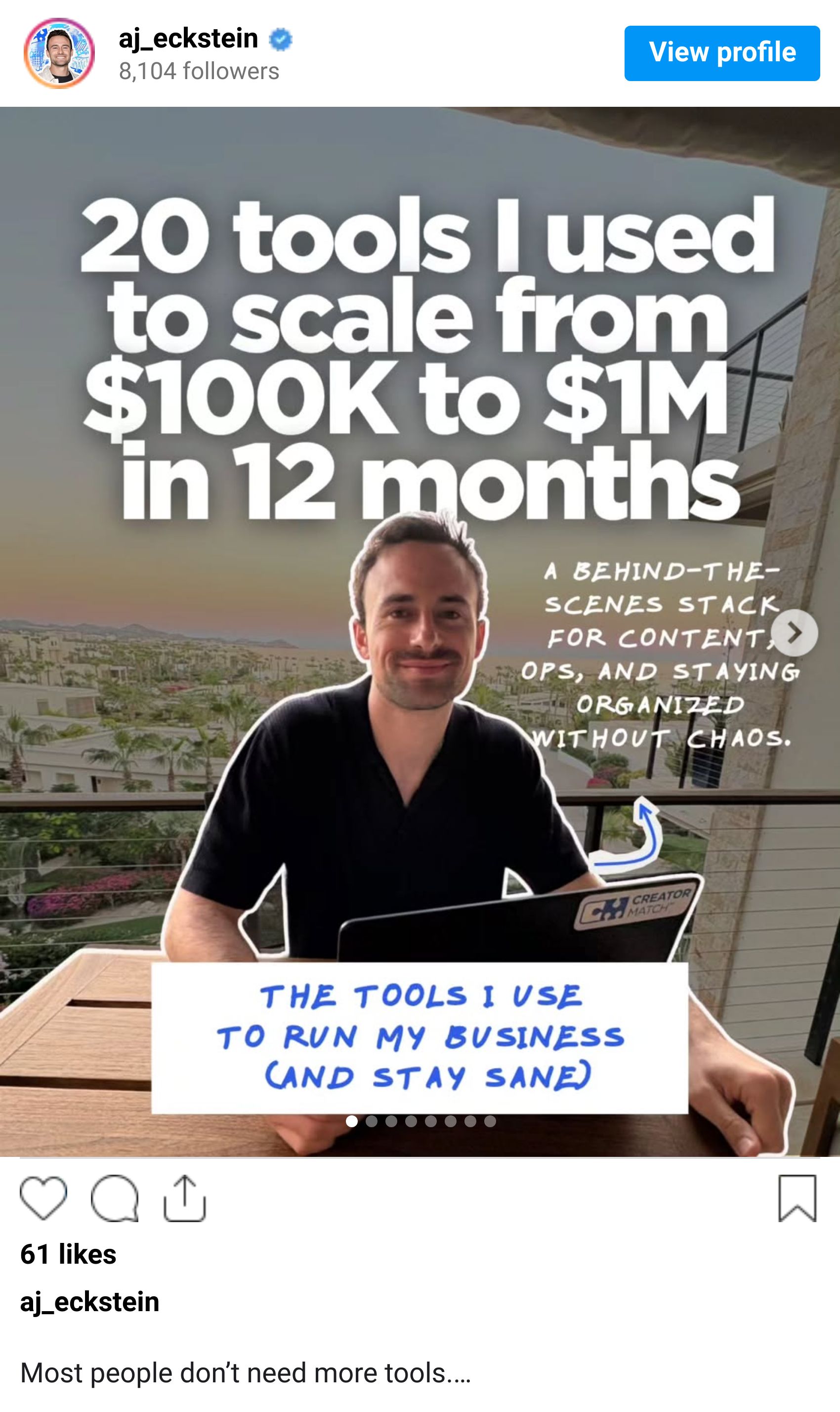
A: The only way to balance both when you're a very busy founder is to document over create. You have to be really mindful and thoughtful about what's going on every day and then document it. I call it my founder journal — I'd recommend this to anyone. If you're not a founder, have a work journal. If you're a creator, have a creator journal.
The only way to balance both when you're a very busy founder is to document over create. You have to be really mindful and thoughtful about what's going on every day and then document it. I call it my founder journal — I'd recommend this to anyone. If you're not a founder, have a work journal. If you're a creator, have a creator journal.
Every single week I document what happened that week — the good, the bad, screenshots. The first time our bank account crossed a certain milestone. When we hired someone we'd been trying to hire for a while. When someone who wasn't the right mutual fit moved on. Everything. So I can go back in a few years and review all my mental notes since the inception of the business.

Every Sunday I review those notes and then create content around the documentation of that week. It's a really easy way to never sit in front of a blank page for five hours. It's not stuff I'm creating new — it's all stuff that just happened.
I also try to include thought leadership: what's going on in the space. This Forbes report came out on the top 50 AI and tech brands in the world, and we work with close to 20% of those brands. But it's not just "congratulate me and buy me a drink" — it's "here's what I'm seeing in this space." I said that the traditional influencer marketing agency cannot keep up with the pace that these tech brands are moving. That's a thought leadership piece. Not just celebrating, but here's my thesis on where this industry is going.
So two main buckets: documenting the business in public, and a couple of thought leadership posts every week.
They don't always perform as well because it's more mid-to-bottom of funnel, but I know exactly who I'm talking to — that brand marketer who has budget and is thinking about creator marketing. Less reach, but really qualified impressions.
Q: How have you seen the ROI from investing in this content?
A: The best marketing is not trackable.
I'm not going to say that this specific piece of content directly led to this dollar amount in sales — I think that's really impossible to attribute. The biggest thing is staying top of mind with my ideal customer profile. I've been building in public since the start of this business. Even before Creator Match, I was talking about what I was doing at Accenture, consulting for some of the biggest tech brands in the world.
What I can say is we see it in the calendar invite — "how did you hear about us?" — and it says “LinkedIn content,” “I saw you on LinkedIn,” etc. I can't pinpoint that one post. But I post every single day, almost like it's a religion. It costs me no dollars, just time.
I encourage everyone on our team to speak up and talk about the amazing things we're doing — a mini employee advocacy program. And I really think that's a big reason why people know about us and think of us.
Here's my analogy: if you have a piece of wood and five nails and you can only take one swing per day, you could spread your hits across all five nails and barely make progress — or you hit the same nail every single day for years. The goal is to get so deep into one nail that when that topic comes up, people think of you, and when they think of you, they think of that topic. We did that with LinkedIn Creator Marketing. When those three words come up, they need to think of us. We nailed that early, and now we're expanding. Outbound content to inbound DMs.
The goal is to get so deep into one nail that when that topic comes up, people think of you, and when they think of you, they think of that topic. We did that with LinkedIn Creator Marketing. When those three words come up, they need to think of us. We nailed that early, and now we're expanding. Outbound content to inbound DMs.
Q: What do you wish more creators knew or did? What do you see done wrong?
A: Treat it like a business. We're a business, the brand's a business. I think some creators treat it really professionally, which is always preferred. But I shouldn't have to send five emails, text you, call you, show up at your doorstep to ask for an invoice just to pay you.
Brands and agencies will bend over backwards for creators that respond. Outside of just performance, if you're a good partner, people come back again and again. We know which creators we can tap for last-minute quick turnaround campaigns because we know they'll respond and we have the relationship with them. Creators miss that — they treat it like a side hustle. Even if it is a side hustle, treat it as a main hustle. If you want it to become something real, you have to act like it is. Everyone talks. Do it like a business.
Even if it is a side hustle, treat it as a main hustle. If you want it to become something real, you have to act like it is. Everyone talks. Do it like a business.
Q: Last question: put your tin hat on and make some predictions — where do you think B2B creator marketing is going in three years?
A: A couple of thoughts.
I think the pendulum will swing back. There's going to be a big push against AI avatars and AI creators. Humans want to follow humans. It's going to become so real and confusing that I think there'll be requirements for watermarking AI-generated content — similar to what Sora started doing. There are going to be so many bad actors. You're already seeing UGC with ad spend using fake testimonials, which I believe is technically illegal. There's going to be a huge pushback to the human.
The creators who tell the best stories will survive this. Storytelling goes back to cavemen — people always follow stories. If you're a creator, don't just shoot for virality, shoot for being a storyteller. Casey Neistat is the perfect example — you can tell a story about buying a rug and make it compelling.
The creators who tell the best stories will survive this. Storytelling goes back to cavemen — people always follow stories. If you're a creator, don't just shoot for virality, shoot for being a storyteller.
And I really think creator marketing for AI search will just become a new category. Not enough brands and creators are thinking about this. If you're a creator, start positioning yourself on how to work with brands for AI search presence. If you're a brand, think about how to work with creators at scale so their content ranks against your competitors. It's less "I'm working with this person for reach and relevance" and more "their content helps me rank against my competitors." That's where this is going.
CONNECT WITH AJ
LINKS & THINGS 🗞️
If you loved this Q&A, there’s more where this came from! Some recent highlights: